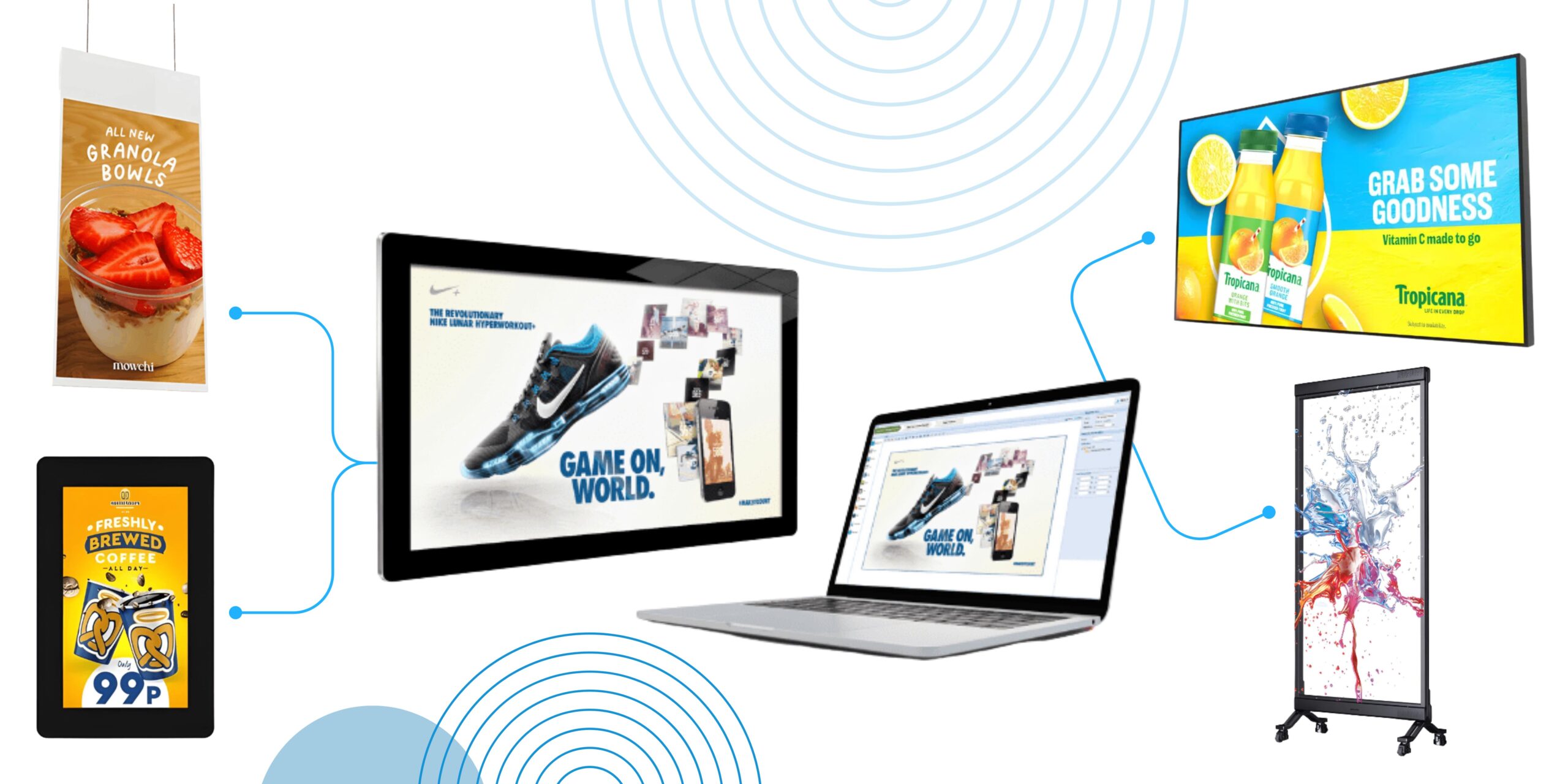



You’re probably wondering, ‘what is a content management system?’ Especially if you’re considering an investment in digital signage. And the simple answer is: A CMS is a cloud-based software designed to streamline your advertising by allowing for remote management of your digital advertising screens. But in reality, a CMS is much more than just a management tool, it is a platform that will revolutionise the way your business operates by centralising your digital advertising activity, giving you greater control over who sees what, when.
Still not sold?
Let’s explore exactly what a content management system can do and why it is worth your investment.
Do I Need a Content Management System?
Digital signage has completely revolutionised the world of advertising, taking static ads and twisting them into dynamic animations and immersive videos in a fairly short period of time. But with this gigantic shift, comes a pressure on brands to catapult themselves into 2026, which can be somewhat straining on budgets – especially for independent retailers who are under more pressure than ever to stand out. Why is this? Well, with our attention spans shorter and a myriad of brands dominating the high street, all competing for the consumer’s attention, digital and innovative content is needed for the immersion of the prospective customer. Most importantly though, content needs to be sharp, and continuously updated to follow seasons and trends, enabling the consumer to stay unequivocally engaged.
A content management system allows you to do this, all in one intuitive platform from anywhere in the world.
So, while a CMS is not a necessity for your digital signage screens, it is a tool that will eradicate the need to manually upload content via USB to each screen manually, giving you centralised control where content can be updated with a simple click of a button.
Content Distribution

Not every business owner is creative, and not every business has a marketing team on hand to do the heavy lifting. But with most intuitive content management systems, creativity isn’t a necessity as you can create advertising content easily with integrated drag and drop builders and editable templates. This is particularly useful if you are a small team and want to get content out quickly. If you do have an internal marketing team however, content created in Canva and Photoshop can be seamlessly uploaded and scheduled within your software.
Once your content has been created and inputted into your software, it can be scheduled, and can be used to push images, graphics and videos to every digital screen in your network – either simultaneously or intermittently, depending on your content strategy. This completely eliminates the need to climb a ladder and inject a USB stick into each screen to upload content manually, making the distribution of your digital content a breeze.
Screen Management

A content management system isn’t just about creating content for your digital signage screens, but it is also a tool for maintaining control over your screens. This means you can monitor health issues, connectivity and power status, allowing you to identify problems quickly from wherever you are in the world and troubleshoot to find the root cause – allowing for a swift resolution.
As well as managing the health of your screens, within your content management software you can schedule downtime and tell each individual screen when to power on and off if you do not want content running 24 hours a day. Again, this mitigates the need to turn each screen on and off manually – saving you time and effort.
Responsive Triggers

A content management system doesn’t just let you create digital content and push it out to your audience, but modern CMS systems also grant you the ability to create content that is 100% responsive to triggers. This means your content can react instantly to real-world actions, including physical presence detection and motion, as well as object pickup and button pressing.
Particularly useful for spaces with extensive foot traffic, including libraries, museums and exhibition halls – responsive triggers allow you to create dynamic signage that reacts to real-world actions. For example, at a historical exhibition, content on screen can change instantly depending on what buttons visitors press.
So, Is It Worth It?
We would definitely say so! So, let’s get down to the nitty-gritty — cost.
When we think of a digital signage screen and its accompanying CMS, we think of a large increase in costs in comparison to static, print advertising. And while the initial cost of a screen and CMS might look eye-watering on paper, you can opt for a one off cost that will eliminate the need to keep spending money to update your print advertisements. Digital signage is known to have a higher ROI in comparison to static advertising, particularly in industries such as retail and hospitality.
Most of our digital signage screens have the option of adding on MySignage, the accompanying content management system for our FutureVisuals range. With this software, there are three content packages available – 1 year at £100, 3 years at £189 or lifetime at £460 – this is the cost per screen.
Want to know more about our content management systems and how they can benefit your business? Contact our friendly and specialist team today!